> For the complete documentation index, see [llms.txt](https://docs.itradingbot.net/llms.txt). Markdown versions of documentation pages are available by appending `.md` to page URLs; this page is available as [Markdown](https://docs.itradingbot.net/en/hedge-robots/aggressive-hedge-parameters.md).
# Aggressive hedge parameters
These settings are for the **Aggressive (VIP)** tab. The levels determine the opening of the opposite position, and the cutting and redemption of the work with the already existing pair. The classical numbers should not be moved without checking the destination of each field.
The procedure for creating and running a task is described in the article [Aggressive hedge: setting and management](/en/hedge-robots/aggressive-hedge-setup-and-management.md).
### General parameters of the task
Minimum volume Minimum value of the loss position at its average entry price, at which the level of the hedge is allowed. With a precise equality threshold, this check has been passed. It does not cancel out the rest of the terms and is not the minimum size of the exchange order.
The percentage of the pair closure the goal of the pair's overall calculation result in percentages of the total cost of the long and short entry. It takes into account the current result of both sides and the accumulated result of the reductions that the robot recorded. It's not a percentage of the deposit; achieving the goal doesn't guarantee a result after execution and expenses.
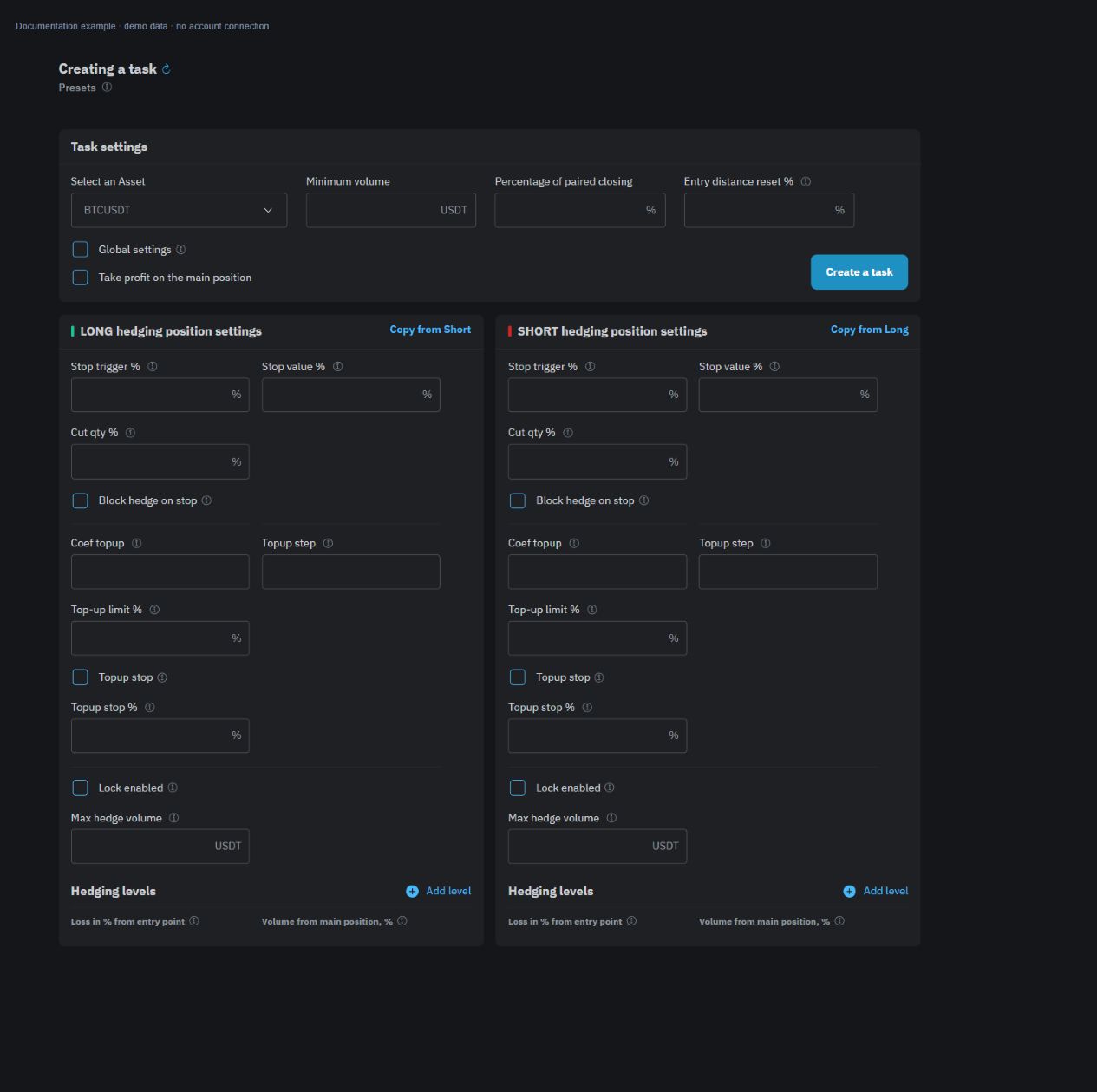
A demonstration of the form of aggressive hedge.
### Levels and position locks
Long level describes the length of the long and the target volume of the opposite shorts. Shorts levels shorts pitch and goal of the opposite long. Each side is set to one to eight levels; the plunge and target volume should be positive and increase sharply along the lines.
The level of is the percentage of the current number of assets in the loss position. The robot chooses the deepest level reached and adds the missing difference to the target. The levels are not folding.
A position lock can limit the hedge's goal to the number of assets in a losing position. When the lock is enabled, **The threshold of the lock** size sets the value of the target hedge above which this limit is included. The zero threshold includes a limitation regardless of the value; the exact equality to the positive threshold does not yet include it.
The threshold is not a hard limit on the value of the position: when the number is activated, the number's goal changes, and the already open excess volume does not close this parameter.
### Trigger and cutting step
For these fields, the direction means the profit side: Long settings control the cutting and redemption of the loss short when the profit hedge is long. Shorts are working with a loss-length.
The trigger of the stake % is the profit change in the price of the hedge in relation to its entry, at which point a cutting chain can be formed. The other side must remain in the dock.
**The value of the stop** % the price of the cutting and redemption grid. The distance is calculated from the total starting price of the net; each next step does not increase the base of the interest calculation. The fields called stop here control the cutting cycle, not repeating the steps of individual parts of the classical hedge.
Cutting percentage, % sets the number of one cut from the maximum observed number of assets in a profitable hedge position for the current escort. The cut partially closes the opposite loss position. If the remainder is insufficient, the planned cuts are reduced; after rounding the order may not pass the instrument's limits.
### Redemption and its Limits
The redemption step the whole number of steps, not less than 2. Before it are cuts: for example, the value 2 means one cut and then a ransom. This is an example of a grid device, not a parameter recommendation.
The buy-back ratio is at least 1. It multiplies the total number of cuts when calculating the recoverable amount; it also takes into account the unrecovered volume of past cycles. A factor above 1 can increase the loss position after the buy-back.
The buy-back limitation of % limits additional growth relative to the maximum amount of asset on the profit side for the current follow-up. The empty field disables this limitation; the permissible filled-in value is from 100.
The restriction does not reduce the already accumulated surplus volume or reduce the redemption to less than the corresponding cuts. For the current grid, its boundary is maintained; field changes affect new cycles.
The buy-back stop includes additional buy-back when the price moves back after the cut is completed. The interest rate is a deviation from the cut price in the opposite direction. This order opens the loss side to restore volume it is not a stop-loss to close the position.
Prohibiting hedging when the loss position increases further prohibits hedging at that party's levels while the appropriate cutting net is installed. Even when the switch is off, the unfinished cutting and redemption cycle can block the new runoff.
### Discount of the difference in the average entry prices
The discharge of the difference of TX % includes a separate operation of reducing and restoring both positions. Zero is banning new operations, but not interrupting the ones that have already begun.
The threshold is checked when the average entry price of a short is higher than the average entry price of a long. The difference is calculated relative to the price of the entrance to the long. To start, you need the same positive numbers on both sides, a sufficient amount of reduction according to the rules of the instrument and no interference with unfinished actions.
The robot reduces both positions to one step of the remaining amount of the instrument, then restores the actually reduced volume by market orders. These are real trades with costs and potential slippage, not just a change in the displayed entry price. Until the operation is complete, the usual strategy is suspended.
### Cancellation of external closing orders
Removing the taek-profit of the main position in aggressive mode affects the external closing orders of both sides. After executing the hedge, the robot tries to cancel the orders already placed, and during active escorting, new ones. Taek-profits, stop-loss and manual closing orders may be checked.
Don't expect these external orders to be automatically restored by the rules of the classical mode. Before you turn on, check what orders already exist and what other tools work with that pair.